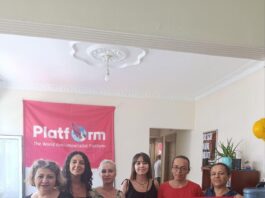
The 3rd Labour Women’s Congress was held in Istanbul on February 21-22 with the theme “Poverty and Forms of Struggle.”
The first day of the two-day congress opened at Nurtepe Cemevi as young women entered with a banner reading “We Will Destroy Capitalism, Young Labour Women Are Coming!” On the first day, with participation from women in the health, education, and service sectors; care workers; students and young women; migrant women; lawyers; retirees; unemployed women; domestic workers; and many women from other sectors, participants discussed poverty, its causes, evaluated the various aspects of life it affects, and held talks on methods of struggle.
The congress began with an opening speech by Çiğdem from Labour Women, followed by a moment of silence in honor of women who have been immortalized in the revolutionary struggle and those murdered by male and state violence.
Following the opening speech, Delal Erol, General Spokesperson of Labour Women, addressed how escalating global wars and the ongoing crisis of the imperialist-capitalist system have intensified poverty. She also presented evaluations based on the results of a survey conducted during the congress preparations to investigate women’s poverty. The survey, carried out in neighborhoods in Istanbul densely populated by working-class people, provided a framework regarding how poverty touches women’s lives, its effects, and consequences. While presenting the survey results, it was noted that the areas most affecting women were economic problems (financial hardship, high cost of living, rent, unemployment, difficulty providing financial support for children, etc.). Women stated that while they exist within families both as laborers and providers of unpaid care work, they often bear the brunt of domestic responsibilities, childcare, and care for the sick, mostly alone. The most common emotional state reported by women participating in the survey was anxiety; they expressed concern not only for themselves but also for their children’s future. In surveys conducted particularly with mothers waiting for their children after school, the most frequently recurring answers regarding difficulties faced were related to the education system, the challenges of the school process, and children’s education. Besides these, the most repeated words in the surveys pertained to femicides, injustice, and the hardships of life after the earthquake.
Evaluations of the survey results emphasized that women demand change. The data showed that women’s most fundamental problem is the economy. However, as reflected in many responses, women do not view the economy merely as a matter of money; they see it as a crisis affecting their entire lives, increasing anxiety about the future and security. Women demand not individual solutions but social and structural changes.
The evaluation concluded: “This survey shows that women are not only experiencing financial hardship; they are simultaneously struggling with poverty, care burdens, insecurity, injustice, and anxiety about the future. Women do not want to endure hunger, exploitation, lack of future, and a life filled with violence any longer; they want a system where they can live in dignity.”
The congress then continued with an Open Forum. The Open Forum, where methods of struggle against poverty were discussed, proceeded with speeches from women from various sectors such as health, education, and services, as well as students, lawyers, unemployed women, young women, retirees, migrant women, and domestic workers. Care workers, women drivers, migrant women, and female students who could not attend the congress sent video messages greeting the gathering.
The second day of the congress continued at the Şişli Ayışığı Ekin Sanat Association. The second day began with the presentation of activity reports covering the work carried out by Labour Women in regions and committees during the one-year period since the 2nd Congress, followed by evaluations of the previous term. Suggestions regarding the committees were constructive for strengthening Labour Women’s activities in the coming period.
The areas where Labour Women will conduct their activities in the upcoming period were shaped by the goal of organizing and expanding the struggle against poverty – which was concretized during the congress preparation process – and the deepening poverty in women’s lives. It was agreed to focus the struggle against poverty as a whole, addressing it not merely as an “economic” issue for women, but also considering its role in increasing violence, its connection to escalating imperialist wars, how it renders women’s domestic labor more invisible and difficult, and how it worsens conditions in the workplace, aiming to involve women in active struggle against these pressing issues.
General evaluations and discussions on organization and activities for the upcoming period contributed to setting goals and discussing methods for Labour Women’s activities to be carried out in the period following the 3rd Labour Women’s Congress.
Our congress discussed the reasons why some established committees were not functioning effectively and decided that new approaches were needed. Changes were made in committees where the Workers’ Women Committee we established did not operate at the desired level and where some of our provincial representatives did not adequately fulfill their responsibilities.
Our congress demonstrated the intense desire of young women to engage in revolutionary struggle and to fight against the problems faced by youth. The growth of our Young Women’s Committee, which we formed with 3 members at the last congress, and its role in forming the backbone of work in many provinces, showed that we can organize in this area. Based on the evaluations made here, it was decided that Labour Women needed to reach more young women and that young women, who are the most affected group among youth whose future is being destroyed, needed to develop an organizational form addressing their own agendas and subjective conditions. Thus, it was decided to form a committee addressing the needs of this area, named the “Young Labour Women’s Committee.”
Our congress revealed that organizing women workers is essential and that this requires persistence and time.
Many speeches delivered at the congress emphasized that none of women’s vital problems can be considered independently of the deep crisis of the imperialist-capitalist system we are experiencing. Recognizing women’s liberation as a matter of revolution, drawing women beyond the confines of gender-based struggle, and making them pioneers of the revolutionary struggle with its class essence is a necessity for winning our freedom. Therefore, conducting women’s struggle intertwined with the struggle against imperialism and capitalism is a crucial foundation for Labour Women. As a result of these evaluations, Labour Women decided to intensify the struggle against NATO, which has declared its intention to “peak” in Turkey in the coming period, and against imperialism, the killers of peoples and women.
The congress decided to continue our international women’s struggle, carried forward through the World Women’s Conference, also via the Anti-Imperialist Women’s Platform.
As the 3rd Congress drew to a close, Labour Women updated and expanded the committees, made new task distributions, and elected new spokespersons. The 3rd Labour Women’s Congress concluded after two days of intense discussions, presentations, and evaluations.
Long live the organized struggle of Labour Women!
22.02.2006
Labour Women